Deliverability Case Study: "Click Through"
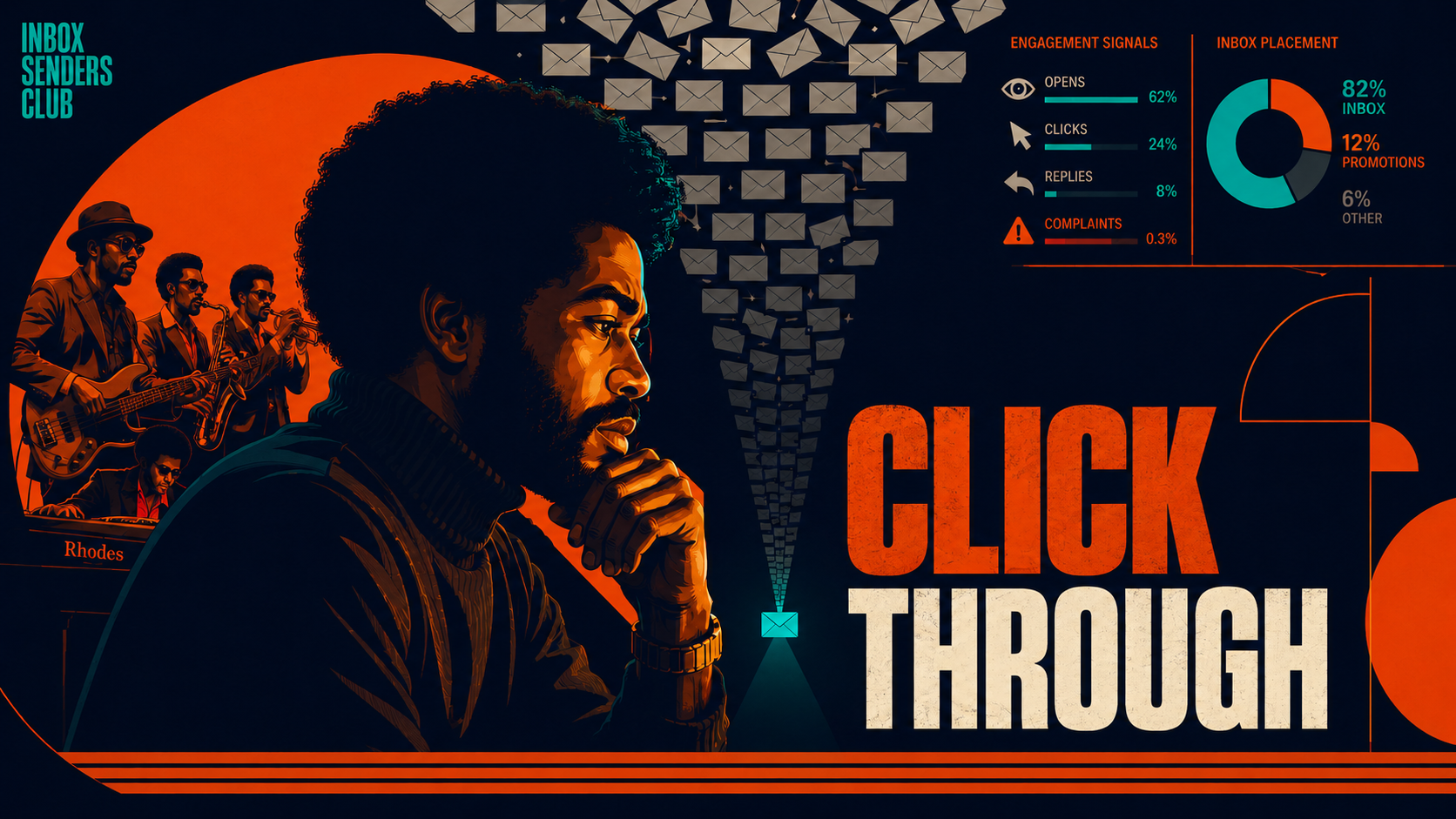
Track 10 of Click Through is the payoff for everything the album built. Ten tracks ago, Marcus Deliverino hit send on a cold domain with no authentication, a purchased list, and complete confidence. The inbox he chased across nine tracks — not just Primary tab, but the deeper concept of reaching a subscriber who wants to read what he sent — was unreachable because he hadn't earned it yet.
Now he has. The send goes out. The analytics update. One click-through appears. Not inflated by Apple's pre-fetch proxy, not a machine traversing links for security scanning, not a bot. A real person received a relevant email, read it, and chose to click the link. That single click is the entire album.
Verse 1: The Four-Step Setup
"List is who I know / Segment confirmed — clean and good to go / The content's right — it answers what they clicked / Domain is warm — the trust is what I built"
The first verse encodes the four-track rebuild in four lines — one per track:
- "List is who I know" (Track 07): The list is built from behavioral signals, not raw volume. Every address on it belongs to someone who has clicked, visited, or purchased.
- "Segment confirmed — clean and good to go" (Track 08): Hard bounces removed. Soft bounces thresholded. Sunset policy applied. The list does not contain addresses that will hurt delivery.
- "The content's right — it answers what they clicked" (Track 09): The email is not a broadcast. It is a response to a specific behavioral signal from each segment.
- "Domain is warm — the trust is what I built" (Tracks 05–06): The domain was rebuilt from the blocklisting event with a correct warm-up protocol. The reputation is earned, not assumed.
Four preconditions. One send. The click-through is the output.
Verse 2: What a Real Click-Through Means
"Not a machine — a human chose to go / That click right there — it's all I need to know"
The distinction between machine-generated clicks and human clicks is not trivial. In modern email analytics, a significant percentage of recorded "clicks" are not human actions:
- Security link scanners: Corporate email gateways and spam filters often follow all links in an email to check for malware and phishing. These clicks appear in ESP dashboards as click events but represent zero human intent.
- Bot traffic: Automated systems scan email links as part of bot-driven data collection. These inflate click counts in high-volume sends.
- Apple Link Tracking Protection (iOS 17+): Apple strips tracking parameters from URLs on some devices, which can cause attribution problems for click analysis.
A click-through from a known subscriber who arrived at a specific product page via a campaign link, on a device and browser consistent with their previous behavior, represents genuine human intent. It is the signal that ISPs weight most heavily because it requires an action that cannot be automated without significant effort.
Marcus's moment of recognizing "a real person's hand" in the analytics data is the track's emotional and technical climax. He is not celebrating volume — he is recognizing the difference between noise and signal.
Bridge: The Bookend
"I started with ten thousand inboxes wide / Each one a stranger — nothing to decide / Now I send to the ones who asked to hear"
The bridge completes the album's arc. Track 01 opened with "ten thousand inboxes ready for more" — strangers, numbers in a database, addresses acquired without relationship. Track 10's bridge returns to that number, acknowledges what it represented, and names the difference: "now I send to the ones who asked to hear."
The inbox Marcus chased in Track 01 and the inbox Marcus earned in Track 10 are the same technical destination — but they are opposite relationships. One was a target. The other is a trust.
Click-through rate is the gold standard engagement signal because it requires intent. An open can be triggered by a machine. A click requires a human to read the email, notice the link, and decide to follow it. Building a program that consistently earns real clicks from real subscribers is the complete description of email deliverability done right.
Understanding Click-Through Rate as a Health Metric
Click-through rate (CTR) measures the percentage of total sends that produce at least one click. Click-to-open rate (CTOR) measures clicks as a percentage of openers. Both are useful for different purposes:
- CTR reflects the overall health of your list, your deliverability, and your content in a single number. It is the metric to optimize at the program level.
- CTOR reflects content quality among those who saw the email. A high CTOR with a low CTR means the content is compelling but not enough subscribers are seeing it — a deliverability or subject line problem. A low CTOR with a high CTR means subscribers are opening but not finding the content worth acting on.
Healthy consumer email programs typically see CTR between 1–3% and CTOR between 10–20%. These benchmarks vary significantly by industry and frequency.
Distinguishing Human Clicks from Bot and Machine Clicks
Bot and machine clicks inflate click metrics and make campaign optimization unreliable. Identifying and filtering them is a data hygiene practice:
- Temporal clustering: Bot clicks often arrive in the first minutes after a campaign send, as scanning systems process new mail immediately. Cluster analysis of click timestamps can identify bot spikes (many clicks in the first 60 seconds) versus human click patterns (distributed over hours and days).
- Click velocity: A single subscriber who triggers many clicks in rapid succession (100 clicks in 30 seconds) is almost certainly a link scanner. Most ESPs can be configured to deduplicate or flag these events.
- Landing page behavior: A real click followed by zero landing page engagement (immediate bounce, no page views, no time on site) is consistent with a security scanner traversing the link and immediately disconnecting. Integrate email click data with site analytics to validate that click events correspond to real sessions.
The Compound Effect of Earned Reputation
A single earned click-through is not just a revenue event — it is a compounding reputation asset. Each real click:
- Adds a positive engagement signal to the sender's reputation record at the ISP
- Improves the probability that the next send from the same domain lands in a favorable inbox position for that subscriber
- Contributes to the aggregate domain reputation score that determines deliverability for all subscribers, not just the one who clicked
This compounding effect is why programs built on earned engagement outperform programs built on volume over time. The difference is not immediately visible in campaign-level metrics — it shows up over months, as
inbox placement rate climbs,
complaint rate stays low, and deliverability becomes a solved problem rather than a recurring crisis.
The click-through Marcus earns in Track 10 is the beginning of a program, not the end of a story. Every subsequent send either adds to or subtracts from the reputation capital that click helped build. The craft is maintaining that balance — one relevant email, to one real subscriber, one send at a time.
Educational content. Email deliverability evolves rapidly. Platform rules (Gmail, Yahoo, etc.), engagement signals, and ESP behaviours change frequently, and real-world issues often involve conflicting signals, data quality problems, and failure modes that general best practices can’t anticipate. Content on this site is provided for informational purposes only and does not replace a thorough analysis by a qualified deliverability professional.
Terms of Use